

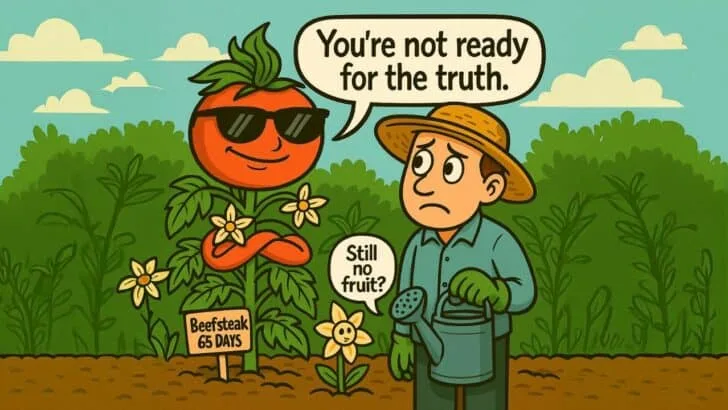
Your tomato plants are growing like champions. Leaves look lush, stems are thick, they’re climbing up their cages like they’re training for the Olympics. And yet… no tomatoes. Not a single one. Just a bunch of flowers that either fall off or sit there doing nothing.
If that sounds familiar, you’re not alone. June is exactly when this kind of thing starts driving gardeners up the wall. Everything looks like it’s working, but your tomato plants are basically just taking up space and making excuses.
This isn’t a sign that you’ve failed. It’s a sign that your tomatoes are being dramatic — and that they need a few nudges in the right direction. In this article, we’re going to walk you through the most common reasons your tomato plants are holding out on you, and what you can do to finally get some fruit on those vines.
- Tomato plants can look healthy but still delay fruiting due to several common issues.
- Too much nitrogen encourages leaf growth at the expense of fruit.
- Inadequate pollination often leads to flowers dropping without producing fruit.
- Tomatoes need 6–8 hours of direct sun daily to reliably set fruit.
- Inconsistent watering causes stress and can prevent proper fruit development.
- Extreme temperatures — hot or cold — can temporarily halt fruit production.
- Over-pruning can reduce a plant’s ability to support and develop fruit.
- Most tomato varieties take 20–30 days after flowering to start showing fruit.
- Stay patient and consistent — a healthy plant will usually fruit in its own time.
Your Flowers Show Up, Then Drop Off
Tomato flowers are dramatic little divas. If conditions aren’t just right, they’ll throw a tantrum and fall off without ever turning into fruit. This is called “blossom drop,” and it’s almost always linked to poor pollination. Even if you’ve got bees buzzing around, it might not be enough — especially with modern hybrid tomatoes that are fussier than your grandma’s prized rose bush.
Pollination doesn’t just happen magically. Tomatoes are self-pollinating, yes, but they still need a bit of motion to transfer pollen. No motion, no fruit — just a plant with commitment issues.
- Give your plants a gentle shake every couple of days when they’re flowering. Seriously. Just grab the stem and wiggle it. That mimics wind or buzzing pollinators.
- You can also use an electric toothbrush held near the flower clusters to vibrate the pollen loose. Weird? Yes. Effective? Also yes.
- Consider planting flowers nearby that attract pollinators — borage, marigolds, and lavender are great companions.
- If pollination is still poor, use a blossom set spray to help boost fruit formation artificially.
Your Plants Are All Leaves and No Fruit
This is the classic sign of a tomato plant that’s been overfed on nitrogen. It’s like giving your kid endless Red Bull and wondering why they’re bouncing off the walls instead of doing their homework. Nitrogen helps plants grow green and leafy, sure. But too much, and all that energy goes into vanity — not productivity.
- Stop using high-nitrogen fertilizer immediately. Check your product’s N-P-K ratio — if the first number is high, that’s your culprit.
- Switch to a low-nitrogen, higher-phosphorus fertilizer (like 5-10-10) to encourage fruiting.
- If your soil is already too rich, consider watering deeply a few times to help leach excess nitrogen out.
- In raised beds, you can also mix in extra carbon-rich compost to help rebalance things over time.
Your Plants Aren’t Getting Enough Sun
Tomatoes aren’t shy. They like attention, heat, and at least 6 to 8 hours of direct sunlight a day — no exceptions. If your tomato plant is lounging in dappled shade or getting only morning light, it might grow fine and even flower, but you’ll be waiting a long time for actual fruit.
Even experienced gardeners get caught by this. Maybe the sun angle has shifted, or your plants got a little too cozy next to something taller. Or maybe those big beautiful leaves are casting more shade than you thought. Either way, tomatoes in low light are like teenagers with no Wi-Fi: they’ll just sit there doing absolutely nothing.
- Track how much **direct sunlight** your plants actually get each day — not just “brightness,” but full-on, no-obstruction sun.
- If it’s under 6 hours, consider relocating your container plants or using reflective surfaces (like white panels or aluminum foil) to bounce extra light in.
- Prune back overgrown leaves or nearby plants that might be hogging the spotlight.
- If nothing else works, use a grow light on a timer for an extra boost, especially in partially shaded patios or balconies.
You’re Watering Wrong (Without Realizing It)
Tomatoes are picky about water — not too much, not too little, and definitely not a rollercoaster of drought and flood. The problem is, a lot of us are watering based on guesswork. And tomato roots aren’t big fans of surprises. If your watering schedule is inconsistent, or if you’re just splashing the surface without soaking the root zone, your plants will stress out and either drop flowers or refuse to set fruit altogether.
Inconsistent moisture is also one of the top causes of blossom-end rot later in the season, so getting your watering game right now can save you a lot of heartbreak (and weird-looking tomatoes) in July.
- Water deeply and slowly, aiming for the soil to be moist about 6 inches down. Use your finger or a moisture meter to check.
- Stick to a consistent schedule — ideally early in the morning before the heat kicks in.
- Mulch around the base of the plant with straw, compost, or shredded leaves to keep soil moisture even.
- In containers, expect to water daily or even twice a day if it’s hot. Pots dry out faster than you think.
Your Tomatoes Are Having a Temperature Tantrum
Tomatoes may be summer stars, but they’re not as heat-tolerant as people think. If daytime temps climb above 85°F or nighttime temps drop below 55°F, they stop fruiting. Not because they’re damaged, but because they’re dramatic. The plant pauses fruit production like it’s on strike, waiting for conditions to be just right before it gets back to business.
This is especially common in early summer when nights are still cooler in some parts of the US or when an early heatwave shows up uninvited. Your plant might still flower, but fruit set? Forget it. Not until it feels like the thermostat situation has been resolved.
- If nights are still dropping below 55°F, cover your plants with a lightweight row cover or garden blanket overnight.
- During hot spells, provide partial shade during the afternoon with shade cloth or even a strategically placed patio umbrella.
- Mulch the soil to keep root temperatures stable — tomatoes hate root shock.
- If your plant stops fruiting during a heatwave, don’t panic. Just keep it healthy and wait it out — fruiting will resume once the weather calms down.
You’re Over-Pruning Like a Tomato Barber
Yes, pruning helps airflow and can encourage stronger growth — but there’s a fine line between tidy and traumatized. If you’re snipping every sucker, every leaf, and every stem that looks remotely “extra,” your plant might just stop trying. It needs those leaves for photosynthesis, and it needs some of those suckers for future fruit production.
Pruning should be thoughtful, not ruthless. Tomato plants are surprisingly forgiving, but if you take off too much, too fast, or too often, they’ll slow down and focus on healing rather than making tomatoes.
- Focus on removing suckers below the first flower cluster. These are the least productive and most likely to crowd the base.
- Leave upper suckers alone unless the plant is wildly overgrown. These often turn into full fruiting branches.
- Never remove more than 20–25% of the plant at one time. Prune gradually and observe how the plant responds.
- Keep your shears clean to avoid spreading disease — a quick wipe with alcohol between cuts does the trick.
When You’ll Actually Start Seeing Tomatoes
If your tomato plant looks healthy and you’ve dealt with the usual suspects — nutrients, water, light, pruning, pollination — then chances are, you just need to wait a little longer. Tomatoes aren’t fast. Most varieties take anywhere from 20 to 30 days after flowering to produce fruit you can see, and another few weeks before it’s ready to harvest.
In other words: if your plant has just started flowering in early to mid-June, you’re probably right on track. Don’t rip it out in frustration just yet. Some heirloom and beefsteak types are especially slow to get going, while cherry tomatoes usually show off first.
- Look up the “days to maturity” on your seed packet or plant label. Most fall between 60–85 days from transplant.
- Count 3–5 weeks from the first flowers before expecting to see baby fruit forming.
- Keep the plant well-fed, well-watered, and in full sun — no drastic changes while it’s gearing up to fruit.
- Be patient. A healthy plant with flowers *will* fruit when the timing’s right. Sometimes they’re just late bloomers.
I know how frustrating it can be to do everything right and still feel like your tomatoes are dragging their feet. But in many cases, it’s not a problem — it’s just timing. Tomatoes don’t rush, and sometimes a little patience is the best fertilizer of all.
One of my plants this year took its sweet time too — healthy, full of flowers, but no fruit for weeks. A few small adjustments made all the difference. If you’ve ruled out the common issues above, chances are your tomatoes just need a bit more time, consistency, and encouragement.


Daniel has been a plant enthusiast for over 20 years. He owns hundreds of houseplants and prepares for the chili growing seasons yearly with great anticipation. His favorite plants are plant species in the Araceae family, such as Monstera, Philodendron, and Anthurium. He also loves gardening and is growing hot peppers, tomatoes, and many more vegetables.