

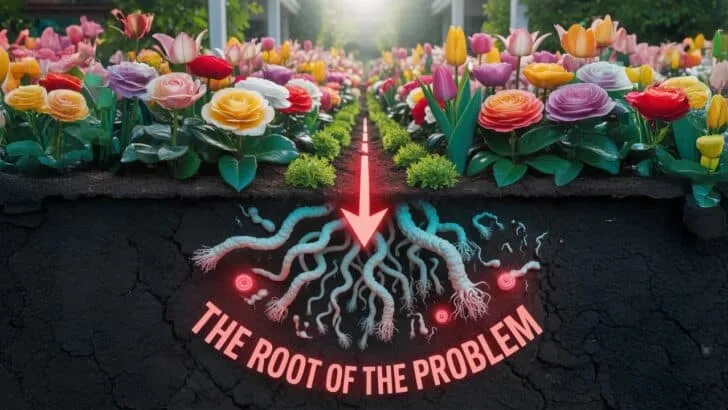
Everything looks fine. The flowers are blooming, the mulch is fresh, and the watering can’s getting a workout. And yet, something’s not right. Leaves yellow. Growth stalls. Plants that should be thriving start acting like they’re auditioning for a tragedy.
Here’s the kicker: it’s not something you did wrong yesterday. It’s what you can’t see today — right beneath the surface, inside the soil, or floating quietly in your garden’s microclimate. The invisible assassins are the worst kind, and they’re out in full force.
This list is for gardeners who’ve done “everything right” and still watched things go sideways. Because sometimes, the culprit isn’t obvious — but it’s definitely there.
🌱 Key Takeaways
- 🧪 Looks can be deceiving — even healthy-looking soil can hide issues that slowly choke your plants.
- 🔬 The most dangerous problems are invisible — think microscopic pests, chemical residue, and pH imbalances.
- 🛠️ Fixing these issues isn’t guesswork — with the right tests, tools, and attention, you can bring your garden back from the brink.
- 🧠 Knowing is half the battle — once you’re aware of these silent threats, you’ll never garden the same way again (and that’s a good thing).
- 🌼 Healthy gardens start below the surface — focus less on the flowers and more on what’s happening underground.
1. Soil pH Imbalance
Your soil might look perfect — dark, crumbly, rich. But if the pH is off, your plants might as well be sitting in gravel. When the acidity or alkalinity drifts too far in either direction, essential nutrients like nitrogen, phosphorus, and potassium become chemically locked up. That means even if you’re fertilizing correctly, your plants can’t access the buffet. They’re starving with a full fridge.
Symptoms aren’t always dramatic. You might see slow growth, yellowing leaves, or odd blotches. But if you’ve ruled out pests and watering issues, your soil’s pH could be the silent saboteur.
🧪 What You Can Do
- Test your soil’s pH using a cheap at-home kit or send a sample to your local extension office.
- Too acidic (pH under 6)? Add lime to raise it gradually.
- Too alkaline (pH over 7.5)? Use sulfur or organic matter like pine needles to bring it down.
- Re-test in a few weeks — pH correction takes time but is 100% worth it.
2. Compacted Soil
From above, your soil might seem fine — you can rake it, plant in it, water it. But underneath? It could be a brick. Years of foot traffic, heavy rains, or even repeated tilling can compress soil particles so tightly that roots can’t push through. Water just pools on top or runs off. Oxygen? Forget it.
Compacted soil doesn’t always crack or crust. Sometimes it holds moisture like a swamp but still leaves your plants thirsty because the roots can’t breathe or spread. You’ll see stunted growth, wilted leaves, or plants that look miserable for no obvious reason.
🚜 How to Check and Fix It
- Stick a screwdriver or stake into the soil. If it’s hard to push in, you’ve got compaction.
- Aerate manually with a garden fork, or rent an aerator if it’s a lawn.
- Layer on compost or mulch to improve texture over time without tilling.
- Avoid stepping directly in beds — use stepping stones or boards to distribute weight.
3. Microscopic Pests (Like Root Nematodes)
You won’t see them. You won’t hear them. But they’re there, hijacking your garden underground like tiny, invisible vampires. Root nematodes are microscopic worms that invade plant roots and slowly drain the life out of them. You’ll get yellowing leaves, stunted growth, and a sickly plant — even if the soil looks perfect and the watering is on point.
They’re especially common in sandy soils and love warm climates, but they can pop up just about anywhere. Once they’re in, they invite all sorts of other problems. It’s like giving your plant a flu and then sending it into battle.
🧪 How to Spot and Stop Them
- Check roots when pulling plants — if they’re knotted or lumpy, nematodes might be to blame.
- Send a soil sample to a local extension office for nematode testing if symptoms persist.
- Solarize the soil by covering it with clear plastic for 4–6 weeks during peak summer heat.
- Rotate crops and plant resistant varieties like marigolds to naturally reduce populations.
4. Fungal Spores in the Soil
One day your plant looks fine. The next, it’s flopped over like it just gave up on life. The culprit? Fungal spores like fusarium, pythium, or rhizoctonia — microscopic pathogens that live in the soil and strike when the conditions are just right (read: too wet, too warm, too stagnant). They sneak in through the roots, travel upward, and cause rot, wilt, and collapse. You don’t see the spores, just the heartbreak.
Seedlings are especially vulnerable, but even mature plants can fall victim if the soil stays soggy or airflow is poor. And worst of all? By the time you notice symptoms, it’s usually too late to save the plant.
🧫 What to Look for — and What to Do
- Watch for bottom-up wilting that doesn’t improve after watering — that’s a red flag.
- Check roots — if they’re brown and mushy instead of white and firm, fungal rot is likely.
- Improve drainage with raised beds or compost-rich soil.
- Don’t overwater and always space plants for airflow.
- Use disease-resistant varieties and rotate crops every year.
5. Excess Salts from Fertilizers
You feed your plants with love — and a scoop of fertilizer — and expect them to thank you with blooms and bounty. But over time, especially with synthetic fertilizers, salts build up in the soil like residue on a coffee pot. You won’t see it unless the soil crusts over or leaves start curling and crisping for no good reason.
These salts can block water uptake, burn delicate roots, and mess with nutrient absorption. It’s like giving your plants a buffet they can’t digest. And the worst part? The damage sneaks in slowly, so you might not connect the dots until the soil’s already hostile.
🥄 Signs & Solutions for Fertilizer Salt Buildup
- Look for white crusts on the soil surface or pot edges — that’s salt.
- Notice curling, brown-edged leaves? Could be salt burn, not drought.
- Flush the soil with deep, slow watering to leach out salts (especially in pots).
- Switch to organic fertilizer or compost, which breaks down more gently.
- Fertilize less often — monthly is usually enough for most plants.
6. Invisible Gas Exchange Problems
It’s not glamorous, but your plants breathe. Not with lungs, but through roots that need oxygen just as much as water. When soil stays soggy or compacted, gas exchange shuts down. Roots suffocate. And once they do, the plant starts to collapse — not because it’s hungry or dry, but because it’s literally out of breath.
This kind of slow suffocation is common in overwatered containers, poorly draining beds, or raised beds lined with plastic. Your soil might look fine. Your watering might seem reasonable. But if roots can’t get air, they’re doomed. And sadly, most people blame themselves or the plant variety, not the airless underground.
🌬️ How to Fix Root Suffocation
- Stick a pencil or skewer in the soil — if it comes out soggy after days, you’ve got drainage issues.
- Use a lighter soil mix with perlite, bark, or sand to promote airflow in pots and raised beds.
- Don’t line raised beds with impermeable material — let them breathe from the bottom.
- Water deeply but less frequently to encourage deeper, stronger root growth.
- Consider adding worms — nature’s best aerators.
7. Contaminated Compost or Mulch
Compost is supposed to be garden gold. Mulch? A moisture-saving, weed-smothering miracle. But sometimes that “organic matter” you worked so hard to spread turns into the silent assassin of your soil. The culprit? Herbicide contamination. It can sneak in through hay, straw, manure, grass clippings, or even free city mulch — anything that was sprayed with persistent chemicals like aminopyralid or clopyralid.
And here’s the kicker: it doesn’t smell weird. It doesn’t look odd. You only realize something’s off when your seedlings refuse to grow or your tomatoes start curling like they’ve seen a ghost. It’s one of those issues that makes you question everything — your soil, your seeds, your sanity. But it might just be that “natural” compost you trusted a little too much.
🧪 How to Spot It and What to Do
- 🌱 Do a bioassay test: Plant bean or tomato seeds in a few pots filled with the suspect compost. If they grow twisted or stunted, that’s your answer.
- 🚫 Avoid unknown sources: Be cautious with free compost or mulch unless you know exactly what went into it — especially from municipal or farm sources.
- 🧤 Stick to trusted materials: Compost your own kitchen scraps and untreated plant material, or buy certified organic mulch when possible.
- 🧼 If it’s already in the soil: Dig out and discard where possible. Otherwise, plant cover crops like sunflowers or corn that can absorb residues over time.
8. Inconsistent Microclimates
Your garden may seem like one big happy family, but every corner has its own little personality. That sunny patch by the fence? It turns into a frying pan by noon. The spot near the hedge? It’s shady in the morning and blazing hot in the afternoon. These small microclimate differences can spell disaster for plants that aren’t prepared for them.
What’s tricky is that the damage doesn’t show up right away. A plant might look fine for weeks — until one intense heatwave or cloudy spell tips it over the edge. Suddenly, your lettuce bolts, your hydrangeas wilt, or your peppers just stop growing. It’s not the plant’s fault. It’s the environment doing a silent bait and switch.
🌤️ How to Detect It and Adapt
- 🧭 Track sun and shade patterns: Spend a day observing which areas get morning sun, afternoon scorch, or all-day gloom.
- 🌡️ Check surface temperature: Use a soil thermometer or even your hand — some spots get dramatically hotter than others.
- 🚿 Adjust your planting: Heat-lovers (like peppers) thrive in hot corners. Shade fans (like lettuce) need gentler zones.
- 🛡️ Create microclimate buffers: Use umbrellas, shade cloth, or companion plants to soften harsh transitions between sun and shade.
9. Poor Mycorrhizal Activity
There’s an entire underground world working (or not working) for your plants — and it has nothing to do with worms. Mycorrhizal fungi form partnerships with plant roots, extending their reach and helping them absorb water and nutrients. When this invisible network is strong, your garden thrives. When it’s missing or struggling? Plants look fine… until they don’t.
You won’t see mycorrhizal trouble on the surface. No yellow leaves, no pests, no signs of disease. But the plants just seem weak. They’re slow to grow, don’t flower well, and struggle during stress. It’s like they’re missing their underground backup team — because they are.
🕵️ How to Tell and What to Do
- 🔬 Suspect weak root support: If healthy-looking plants underperform with no clear reason, poor fungal activity could be the culprit.
- 🚫 Avoid synthetic fertilizers: Overuse can kill off beneficial fungi. Go easy on the salts.
- 🌱 Add mycorrhizal inoculants: You can buy spores and dust them on roots when planting — especially useful in sterile or disturbed soils.
- 🌿 Use compost and mulch: Organic matter feeds the good microbes and encourages healthy underground life.
- 🪱 Let soil life build: Avoid tilling. Disturbing the soil breaks the fungal network and resets the process.
What You Can’t See Can Kill Your Garden
Just because your garden looks fine from the patio doesn’t mean it’s thriving. The silent killers — the ones you’ll never spot without digging, testing, or watching closely — are the real troublemakers. And most of the time, they don’t show up until the damage is done.
But here’s the good news: the second you know what to look for, you’re already ahead. Whether it’s pH problems, sneaky fungi, or salt buildup from well-meaning fertilizer blasts, these aren’t death sentences. They’re just signals.
Listen to your plants. Watch how they grow. And don’t be afraid to question the soil under your feet.
They’re not trying to be dramatic. They’re just trying to survive.
Daniel has been a plant enthusiast for over 20 years. He owns hundreds of houseplants and prepares for the chili growing seasons yearly with great anticipation. His favorite plants are plant species in the Araceae family, such as Monstera, Philodendron, and Anthurium. He also loves gardening and is growing hot peppers, tomatoes, and many more vegetables.