

You walk in for one plant. Just one. Maybe a six-pack of lettuce starts, maybe a bag of potting mix. But fifteen minutes later, you’re wheeling out a cart that squeaks like it’s trying to warn you. There’s a random hanging basket in there. A cactus you swore you’d never fall for. And three perennials that don’t even match your zone.
Welcome to the garden center. It’s gorgeous. It smells like earth and optimism. And it is engineered to eat your paycheck if you let it.
But you’re not here to get played. You’re here to shop smart, spot the good stuff fast, and leave with plants that are actually worth planting.
These 13 tricks? They’ll save your budget, your time, and your back. Because nobody wants to haul home a half-dead hydrangea just because it was sitting near the entrance.
🌿 Key Takeaways
- 🕗 Shop early in the day to beat the heat and grab the healthiest stock before it’s picked over.
- 🛒 Bring your own cart if you’re buying in bulk. Small carts fill up fast and slow you down.
- 🌱 Don’t trust the front row. Healthier plants are usually tucked toward the middle or back.
- 💬 Ask the right questions. “What dies here?” gets better answers than “Is this easy?”
- 📅 Shop right before seasons change for the biggest markdowns and best last-chance deals.
- 🔍 Check under every pot for root health, moisture level, and hidden signs of stress.
1. Shop early in the morning for the best plants
This isn’t a brunch errand. If you show up after 11, you’re already shopping leftovers. The best plants get scooped up fast — especially the unusual varieties, the healthiest herbs, or anything that doesn’t look half-dead. And don’t forget the heat. By afternoon, even the good stuff starts to look a little wilted. That sad lavender? It looked fantastic three hours ago.
Morning shoppers get the first pick, the freshest plants, and sometimes even better service. Staff aren’t tired yet. No one’s rushed. And if you’re lucky, someone’s still unloading a new shipment in the back.
☀️ Why Morning Matters
- 🌿 Plants are perkiest early in the day before sun stress kicks in.
- 🛒 Stock isn’t picked over yet — you’ll see what arrived fresh.
- 💬 Staff are more available and not juggling ten customers at once.
- 🧠 Your brain makes better decisions before the midday heat fries it.
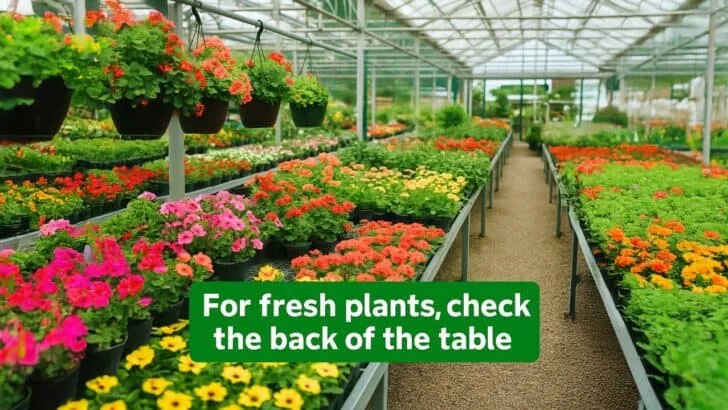
2. Check the back of the table, not the front
The plants up front are the bait. They’re staged, fluffed, and picked over a hundred times before you even walk in. That perfect-looking begonia? It’s been touched, turned, and probably dropped once or twice already. If you’re serious, ignore the display and go straight for the middle or back of the table.
That’s where the quiet survivors live. The ones that haven’t been handled all day. Less bruising, less broken stems, less soil spilled all over the place. It’s also where staff shove the overflow when restocking — meaning better odds of fresher stock hiding just out of sight.
🕵️♀️ Smart Shopping Tip
- 🪴 Middle-row plants are handled less and hold up better.
- 👀 Look for full leaves, upright posture, and firm stems.
- 💡 Avoid impulse buys from the front row. They’re often there to move stock fast.
- 🌱 Flip the trays and look underneath — sometimes, the healthiest stuff is hiding in the shadows.
3. Always peek at the clearance rack — but don’t trust it
Clearance racks are a gamble. Sometimes you hit the jackpot with perennials that just need water and a haircut. Other times, you’re buying a plant that’s already half-composted and too far gone to save. The key is knowing the difference before you load up your cart.
Don’t let yellow leaves scare you off — that’s often fixable. But mushy stems, black spots, or a cloud of fungus gnats when you poke the soil? That’s a no. Use your nose too. If it smells like a swamp, walk away. And always check for hidden pests hitching a ride.
🛒 Clearance Rack Triage
- 💧 Wilted but perky when watered? Probably savable.
- 🍂 Yellowed leaves? Not ideal, but not fatal.
- 🐛 Sticky residue or webbing? Walk away. That’s pest territory.
- 👃 Funky smell? The roots are rotting. No thank you.
- 🔍 Lift the pot and check the roots. White and firm is good. Brown and mushy is not.
4. Ask what’s local and what was trucked in
Not all plants at the garden center started nearby. Some were grown two states over and tossed onto a truck for a bumpy ride. They might look fine now, but once they hit your soil, they fold like a cheap chair.
Local plants have a huge advantage. They’ve already adjusted to the climate, the pests, and the quirks of the region. Trucked-in tropicals often need pampering, and unless your yard feels like a spa, they crash fast. Always ask where a plant came from. A good nursery will tell you.
🌍 What to Ask Before You Buy
- 📍 Was this grown locally or shipped in? Local is usually hardier.
- ❓ How long has it been here? Freshly unloaded plants may still be stressed.
- 🌦️ Will this handle my zone? Some tropicals can’t even handle a cool night.
- 🪴 Ask about the grower — trusted local farms are a green flag.
5. Bring your own cart if you’re serious
Those tiny carts by the door? They’re not a courtesy. They’re a limiter. Most garden centers only put out the small ones up front to keep things moving. But if you’re planning to load up, they’ll fill up in two minutes flat and you’ll be juggling trays like a circus act.
The serious gardeners know the game. They roll in with their own wagon or hunt down the big carts stashed near the loading zone. Some even bring collapsible garden trolleys from home. You’ll get strange looks the first time. The second time, someone will ask where you got it.
🛒 Smart Cart Tips
- 🚗 Check the back parking lot for hidden heavy-duty carts.
- 🧰 Bring bungee cords if you’re hauling large pots or flats.
- 🪴 Group small plants in boxes to avoid tipping them mid-shop.
- 📦 Don’t rely on staff to help load during peak hours. Be self-sufficient.
6. Skip the pre-bagged compost blends
They look tidy. They smell earthy. And they cost way more than they should. Pre-bagged compost is the salad-in-a-bag of the garden world — convenient, but rarely the best pick. The stuff inside could be months old, waterlogged, or full of mystery ingredients no one’s labeling.
If your garden center has bulk bins or mixes their own compost in-house, go there first. It’s usually fresher, cheaper, and far easier to inspect before buying. You can see the texture, smell the quality, and scoop exactly what you need. Plus, you’re not paying extra for fancy packaging and shrink wrap.
🧪 Better Compost Strategy
- 👃 Smell before you buy. Good compost smells rich and earthy, not sour or like ammonia.
- 💰 Ask for half-yard pricing at bulk counters. It’s more than enough for raised beds.
- 🪣 Bring a 5-gallon bucket if you don’t need a full load. Some places allow it.
- 🧺 Check for weed seeds and big chunks. You want fine, dark, and uniform texture.
7. Ask when their deliveries come in
The best plants? They don’t sit around long. And they definitely don’t wait for the weekend crowd. If you know when the fresh shipments arrive, you can be there when the truck’s still cooling down. That means first pick of the healthiest stock before it’s been poked, overwatered, or left in the wrong spot for too long.
Most garden centers have a regular delivery rhythm. Some get plants on Tuesdays. Some reload Fridays for the Saturday rush. Don’t be shy — just ask. Then show up about 30 minutes after unloading starts, and you’ll walk out with the best-looking trays in the place.
📦 Plant Delivery Pro Tips
- 📅 Ask staff when the truck rolls in. It’s often the same day and time each week.
- 🌱 Bring gloves or wipes — new stock can be damp, dirty, or stacked tight.
- 🪴 Look for tags that match the delivery date. That’s how you know it’s fresh.
- 🚗 Pop your trunk with a box or tote inside. New plants can spill or leak soil.
8. Don’t buy anything blooming at full blast
It’s tempting. You see those vibrant flowers screaming for attention, and you think, “Perfect.” But if it’s blooming like crazy in the store, you’ve already missed the peak. What you’re buying is the tail end of the show. Once it’s home, it’ll sulk, drop petals, and call it a day.
Instead, look for plants that are just starting to bud. You want tight blooms, healthy leaves, and signs that the best is still ahead. That way, you get the full bloom cycle in your own garden, not just a leftover encore in a plastic pot.
🌼 What to Check Before You Buy
- 🔍 Look for buds, not blossoms. Tight clusters mean fresh growth is coming.
- 🍃 Inspect the leaves. Yellowing or holes mean the plant’s under stress.
- 🧼 Check the soil moisture. Too dry or too wet can shorten bloom life fast.
- 🎯 Bonus points for new growth at the base. That’s a plant still investing in itself.
9. Look under the pot, not just inside it
The top might look fine. Perky leaves. Nice color. Maybe even a flower or two. But the real story is hiding underneath. Flip the pot or at least peek at the drainage holes. Are the roots spilling out like spaghetti? Is the bottom soaked? Mushy? Cracked?
That’s where the truth lives. Healthy roots mean a plant that’s ready to thrive. A rootbound, bone-dry, or slimy-bottomed one is already in trouble. Don’t get fooled by surface-level charm. The bottom of the pot is like reading someone’s browser history. It never lies.
🔍 What to Spot Underneath
- 🧠 Roots poking out? Might need repotting immediately.
- 🧊 Cold, wet base? Could mean root rot is already starting.
- 🪵 Dried, crumbly soil? Likely water-stressed or neglected.
- 🪱 Surprise visitors? Slugs, pill bugs, or ants are a red flag.
10. Carry a plant tag cheat sheet on your phone
Plant tags are unreliable. Some give just enough info to confuse you. Others read like marketing poetry. “Hardy” doesn’t mean winterproof. “Part sun” can mean anything. And don’t count on staff knowing every cultivar on the lot.
If you’re serious, make your own cheat sheet. Keep a list of your favorite reliable varieties, ones that failed you, and what your zone actually allows. Add quick notes on spacing, watering habits, and what pests love to chew them. That way, you’re not relying on a laminated card stuck in dirt.
📱 Your Plant Tag Survival Kit
- 📸 Snap plant tags to compare later at home.
- 📝 List no-gos for your garden like invasive species or mildew magnets.
- 🌱 Track what worked and what croaked. Bonus if you note where and why.
- 💡 Add shorthand cues like “slug bait” or “full sun or bust.”
11. Never ask “Is this easy?” Ask “What dies here?”
“Is this easy to grow?” is the wrong question. Every plant feels easy when you give it what it wants. And nearly every plant turns fussy when you don’t. What you really want to know is what consistently fails in your area, in your soil, and in your conditions.
So ask the staff what dies here. What gets returned. What people complain about. A good nursery worker will tell you if you ask the right way. And if they dodge the question, that’s your cue to trust your gut and maybe ask someone else — or look it up while standing in the aisle.
🧠 Smart Questions to Ask Instead
- ❌ “What’s tricky around here?”
- 🌿 “What needs babying in our heat?”
- 👎 “What do people regret buying?”
- ✅ “What sells out fast every year?”
12. Hit the center, not the edges
The side tables? That’s where overstock lives. Or sad promotional filler trying to look perky in the sun. The real gems are tucked in the middle, where the layout doesn’t scream for attention but the plants quietly thrive.
The center racks are usually where the serious growers put their best. These are the plants that came in first, sold best, and were restocked quickly. If something looks a little too perfect up front, there’s a chance it was rotated from the back just to catch your eye.
🛒 Smart Plant-Hunting Tactics
- 👀 Start in the middle of the greenhouse, not the flashy display
- 🌱 Look for grouped flats that are half-picked — that means they’re popular and fresh
- 🧤 Move a few pots to the side and check the second row — often less handled and healthier
- 📦 Avoid anything next to a “promo” sign unless you’d buy it full price
13. Shop right before a season change
This is when the magic happens. Garden centers hate holding inventory that is about to go out of style. Late-summer perennials? They’re practically giving them away. Fall bulbs right before winter? You could walk out with bags of them for the price of a latte.
The key is to time it right. Not too early or you’ll pay full price. Not too late or it will all be picked over and sad. A few days before a big seasonal shift is your sweet spot. Walk in, smile politely, and head straight for the shelves they are trying to clear before the new stock arrives.
💸 Timing Tricks That Save Big
- 🗓️ Watch the calendar. Most stores flip inventory fast near the end of each month.
- 🪴 Ask staff when seasonal markdowns start. They’ll often tell you straight up.
- 💰 Buy now, plant later. Just keep the roots moist and shaded till you’re ready.
- 🏷️ Check for multi-buy deals. A $5 perennial becomes $2 when it’s the last one left.
🛒 Why the Best Gardeners Shop Like Pros
Buying plants isn’t about luck. It’s about spotting the clues that most people miss. The heat-wilted ones in front. The quiet winners in the middle rows. The staff who know which delivery just came in and which plants were trucked in from three zones away.
Great gardeners don’t just grow things well. They shop well. They know when to hold back, when to splurge, and when to walk away from a plant that looks good but feels wrong. That’s the part nobody talks about. The behind-the-scenes moves that set your garden up for an easier season.
Because the truth is, your smartest gardening decisions often happen with a cart in hand and dirt under your nails, long before anything goes into the ground.


Daniel has been a plant enthusiast for over 20 years. He owns hundreds of houseplants and prepares for the chili growing seasons yearly with great anticipation. His favorite plants are plant species in the Araceae family, such as Monstera, Philodendron, and Anthurium. He also loves gardening and is growing hot peppers, tomatoes, and many more vegetables.