

It’s the same every summer. The sun gets mean. The hose comes out. And the water bill? It climbs like ivy on a fence.
But here’s what’s strange. Just when your garden starts gasping, you notice a neighbor’s patch — lush, green, thriving — without a sprinkler in sight.
It doesn’t make sense at first. The bed looks like a mistake. Uneven. Piled high. More like a compost dump than a garden. But somehow, everything in it is alive. Not just alive — thriving while everything else bakes in the heat.
It looks like a pile of debris. It smells like compost. But it works. Here’s what’s going on.
The name sounds complicated. The results aren’t. Meet Hugelkultur.
What the Heck Is Hugelkultur?
Hugelkultur. Sounds like a board game. Or maybe something you’d catch a cold from.
But in the gardening world, it’s one of the oldest, strangest, and most genius ways to build a garden bed — and it comes straight out of Central Europe, where gardeners have been doing this for centuries.
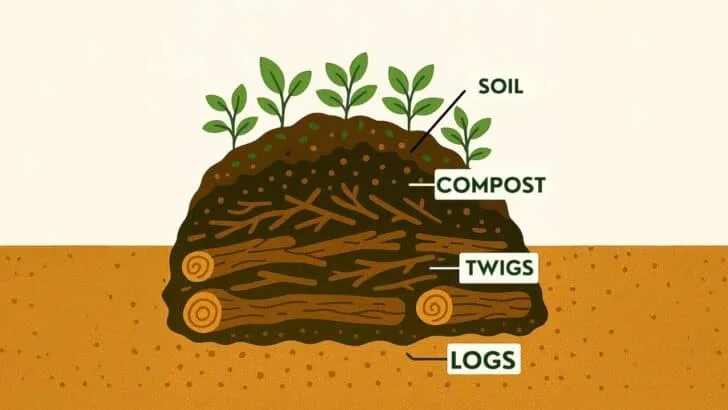
Here’s the basic idea. You take a bunch of old wood — logs, branches, sticks — and pile them up. Then you cover that mess with compost, leaves, maybe some kitchen scraps, and top the whole thing with soil. The result? A raised mound that looks a little chaotic on day one… and incredibly lush by day fifty.
The method mimics what happens naturally in a forest. A tree falls. It breaks down slowly. It holds moisture, feeds fungi, and creates the perfect conditions for new growth. Hugelkultur just fast-tracks that process and lets you grow vegetables right on top.
It’s low-tech, low-maintenance, and weirdly beautiful once things start growing. And most of all? It works like the forest intended — from the ground up.
Why Hugelkultur Actually Works
At first glance, it just looks like a pile of debris with a garden on top. But the inside of a Hügel bed is quietly pulling off five miracles at once.
🌧️ Moisture retention? Those logs soak up rain like a sponge. Even in dry spells, the mound stays damp inside — meaning less watering for you, and fewer plant meltdowns in July.
🐛 Soil life? All that buried wood becomes a playground for fungi, worms, and microbes. It’s like setting up an underground city of composters who work for free.
🌿 Nutrient release? As the wood and compost break down, they feed your plants slowly — no need for constant fertilizer. It’s the garden equivalent of slow-cooked soup.
🔥 Early warming? The mound structure helps it warm up faster in spring, giving your plants a head start when everything else is still half-asleep.
🙌 Less weeding and digging? The raised shape discourages weed growth and spares your back. No need to till. Just top it up, plant, and watch it do its thing.
✅ Quick Recap of Hügelkultur Benefits
- 💧 Holds water like a sponge — less watering needed
- 🌱 Feeds your plants slowly over time
- 🪱 Creates a thriving underground ecosystem
- 🌞 Warms up earlier in spring
- 🧘♀️ Reduces weeding and digging
What You Need to Build One
Here’s the good news. You don’t need blueprints, a backhoe, or a permit from your local garden council. If you’ve got sticks and an afternoon, you’ve got what it takes.
Here’s your shopping list — and most of it is free:
- 🪵 Logs and big branches (rotting is fine — actually, it’s perfect)
- 🌿 Twigs, sticks, and smaller woody debris
- 🍂 Grass clippings, old leaves, straw, dead plants
- 💩 Compost, manure, or anything organic and gross in a good way
- 🧺 Topsoil to cap it all off
What not to use? Black walnut (it poisons the soil). Cedar and redwood (too rot-resistant to break down). Treated lumber (just no).
You also don’t need power tools. A handsaw will do. Or a stubborn streak and a pair of gloves.
If it looks like garden garbage, it’s probably perfect. The only real rule? Stack it like you mean it. Layers matter more than symmetry.
🪵 Pro Tip
You don’t need a chainsaw or a tractor. If your neighbor just trimmed a tree and you’ve got a wheelbarrow, you’re in business.
Step-by-Step Setup
Building a Hügelkultur bed feels a bit like stacking forest leftovers into a giant lasagna. But instead of cheese, you get tomatoes. Instead of noodles, you get logs.
Here’s how to make it happen, without overthinking it:
- Dig a shallow trench (optional). About 1 foot deep. This helps anchor the logs so they don’t shift later.
- Lay down the biggest logs first. These form the spine of your mound and act like water tanks.
- Stack on branches and twigs. The messier it looks now, the better it breaks down later.
- Add organic matter. Kitchen scraps, grass clippings, half-finished compost — dump it all in.
- Top with soil. You want about 6–12 inches of actual plantable earth above the rest.
- Plant directly into the mound. Root veggies on the sides. Thirsty stuff on top. Tough guys near the bottom.
That’s it. No cement. No power tools. No perfect symmetry. Just a slow-cooking hill of fertility, built with whatever your yard was already shedding.
🪵 Hügel Tips for Beginners
- Start small — a 3-foot mound is plenty to test it out
- Mulch the top to prevent drying and erosion
- Water once at planting, then let nature take over
- Expect settling — it’s normal for the mound to shrink a bit as it breaks down
When Hugelkultur Is Not a Good Fit
Hugelkultur sounds magical. And honestly, it kind of is. But not every yard is screaming for a giant rotting log pile.
If you’re working with a postage-stamp lawn in suburbia, the neighbors might start asking questions. If you’ve got heavy clay soil, you may need to prep extra so the base doesn’t become a soggy pit. And if you’re part of an HOA? Well… that’s a separate battle.
It’s okay to admire Hugelkultur and still say “not this year.” You don’t need to go full forest floor to garden smarter. But if you’ve got the space, the scraps, and the spirit of mild garden rebellion, it just might be your favorite new experiment.
💡 Pro Tip
If your neighborhood frowns at compost hills, call it a “permaculture-inspired raised bed.” No one argues with permaculture.
What a Rotting Log Pile Teaches You
Gardening doesn’t have to mean constant work. Sometimes, the smartest move is to let nature carry the load. Hugelkultur works because it’s not really a trick. It’s just paying attention to what forests have done for centuries.
Rot, decay, layers, and time. These things don’t sound glamorous, but they build the best soil you’ve ever touched. They hold water like a sponge. They keep feeding plants long after the fertilizer runs out.
And the best part? Once your mound is built, it mostly runs itself. You’ll spend less time watering, less time digging, and way less time wondering why your plants look tired.
If you’re into the idea of gardening with forest logic, we’ve got more on that too — [insert link to forest article here].
Because sometimes, the laziest-looking methods are actually the most genius.
🌱 Key Takeaways
- 🌿 Hugelkultur turns old wood into water-saving, nutrient-rich beds that mimic the way forests feed themselves.
- 🧱 It looks scrappy, but it’s smart. Layers of logs, twigs, and compost create a long-lasting mound that keeps plants happy with minimal effort.
- 💧 Less watering, less weeding, and better soil — all without synthetic fertilizers or constant upkeep.
- 🏡 You don’t need a tractor. Just some logs, a shovel, and a willingness to let rot do its thing.
- 📦 Not ideal for every yard, but perfect if you’ve got the space and like the idea of letting nature handle the hard stuff.


Daniel has been a plant enthusiast for over 20 years. He owns hundreds of houseplants and prepares for the chili growing seasons yearly with great anticipation. His favorite plants are plant species in the Araceae family, such as Monstera, Philodendron, and Anthurium. He also loves gardening and is growing hot peppers, tomatoes, and many more vegetables.