

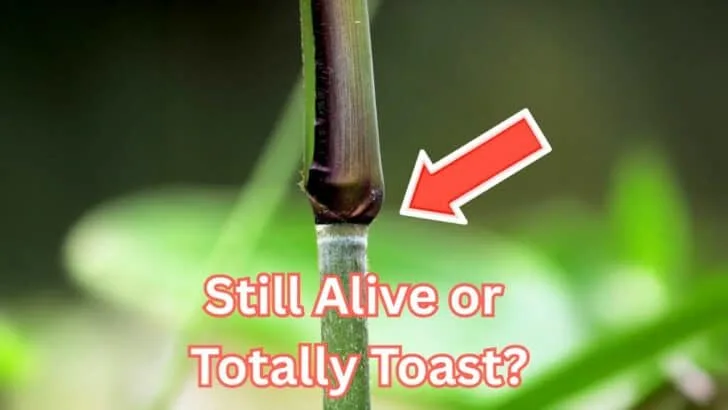
You’ve got a plant that looks like it’s been through a storm, a drought, and maybe a small fire. It’s got three yellowing leaves, a suspicious smell, and exactly zero signs of bouncing back. But still, you’re watering it. Talking to it. Moving it to new spots like some kind of botanical witness protection program.
This is where it gets tricky. Because not every sad plant is doomed, and not every wilted stem deserves a second chance. Sometimes you can bring it back. Other times, you’re just prolonging the suffering — yours and the plant’s.
This guide is here to help you know the difference. What’s worth saving. What’s quietly rotting. And what needs to hit the compost so you can move on with your life (and your shelf space).
🌿 Key Takeaways
- 🪵 Scratch the stem to check for green tissue — it’s the quickest way to test for life.
- 🌱 New growth at the base only means the top is dying back and should be cut.
- 🧪 Funky smells from the pot are a red flag — rot may be setting in below the surface.
- 🔁 If you’ve rescued it more than twice, it might not be a good fit for your space.
- 🍄 Persistent fungus often means the plant is too weak to recover, even with treatment.
- 💔 Keeping a plant for sentimental reasons is sweet, but it won’t bring it back to life.
1. The Stem Test
Before you panic or pot up that scraggly thing for the third time, check the stem. Not the leaves. Not the overall vibe. The stem holds the truth.
Take your fingernail or the edge of a small knife and gently scratch the surface of the stem, starting near the top. You’re not trying to wound the plant — you’re just checking what’s going on underneath the bark.
If the tissue underneath is green and moist, your plant still has life in it. That means it’s trying, even if it looks terrible right now. But if it’s brown, dry, or feels hollow, that section is done. Dead. Not coming back.
Work your way down. Sometimes the top is toast, but the lower stem still has green tissue. That’s a sign you can cut it back and encourage regrowth. But if you scratch all the way to the base and it’s dry all over, it’s not dormant — it’s gone.
🌿 How to Do a Proper Stem Check
- Start at the top: Scratch lightly to reveal the inner layer.
- Look for green: Green means the plant is still alive in that area.
- Move downward: Keep checking lower sections if the top is dry.
- Check the base last: If even the lowest part is dry and brittle, it’s time to let go.
- Use sharp shears: If you find green, prune just above it to give the plant a fresh start.
Pro tip: Don’t confuse a healthy green interior with sap. If it’s mushy or leaking, you may be dealing with rot, not life.
2. Leaf Location Matters
When a plant starts growing again, it tells you where the energy is going. And where it’s not. The location of new leaves is one of the clearest signs of whether your plant is bouncing back or giving up slowly.
Look closely. Are fresh shoots and leaves appearing from the top of the plant, or just from the base near the soil line? If it’s all coming from the bottom, your plant is sending out one last SOS. The main structure may already be shutting down, even if it still looks mostly intact.
Sometimes this means the roots are still alive but the stem or trunk is dying back. That’s not always a death sentence, but it does mean you’re essentially starting over. The top growth won’t recover. The best move in this case is to cut the dead parts and let the healthy new growth take over.
If the new leaves are coming from both the top and base, great. That’s a recovery in progress. But if the top is silent and crispy while the bottom is sprouting, you’re looking at a slow reboot — not a full revival.
🌿 What New Growth Tells You
- 🌱 New growth at the top: The plant is recovering normally.
- 🧼 New growth at the base only: The top is dying back or already dead.
- ✂️ If the top is dry and hollow: Prune it back to where green tissue starts.
- 🔁 Healthy roots + new basal growth: You can regrow the plant from the bottom.
- ❗ No new growth at all: The plant may not have the energy to recover.
3. Root Check = Reality Check
If you’re still unsure whether to save the plant, it’s time to stop guessing and look underground. The roots will tell you everything. Strong roots mean there’s still hope. Rotting, tangled, or dried-up roots mean you’re fighting a battle that was already lost.
Gently slide the plant out of its pot. Don’t yank it. Support the base and tip it sideways. If it’s in the ground, dig carefully around the main stem. The roots should be firm, white or pale tan, and slightly damp. They should smell like soil, not like something fermenting in a jar.
If they’re dark brown, mushy, or fall apart when touched, that’s root rot. If they’re bone dry, stiff, and snapping like toothpicks, they’re dead. And if the roots are circling the pot in tight loops with no structure left in the center, your plant is strangling itself.
You can trim away some damage, but you can’t save a plant with no functional root system. What’s under the soil is the difference between revival and regret. If the roots are shot, it’s compost time.
🌿 Root Check Basics
- 👀 Healthy roots: Pale, firm, and flexible with a mild earthy smell.
- 🧟 Dead roots: Dry, brittle, discolored, and easily broken.
- 💦 Rotting roots: Mushy, black or brown, and may have a foul odor.
- 🪢 Root-bound plants: Circling roots can be saved if trimmed and repotted early.
- ✂️ If over half the roots are gone: The plant will struggle to recover, even with care.
4. Smell Test (Yes, Really)
Your nose is one of the fastest plant diagnostic tools you’ve got. You don’t need fancy meters or soil probes. Just lean in and sniff. If your plant smells clean and earthy, it’s probably fine. If it smells like something died in the pot, you’ve got a problem.
Healthy soil smells like rain. Like compost. Like something alive. But if your plant gives off a sour, swampy, or fermented odor, it’s likely suffering from root rot or bacterial decay. That smell is not normal. It’s the botanical version of a fire alarm.
The trouble is, you can’t always see the damage from above. A plant might look limp or yellow but still appear salvageable — until you notice the scent. A bad smell usually means the roots are drowning, or something deeper is rotting from within.
If you smell trouble, unpot the plant and inspect the roots. Rinse them gently and trim away anything soft, dark, or foul. If there’s nothing left after that, you’ve got your answer. No roots, no recovery.
🌿 What Your Nose Can Tell You
- 👃 Earthy scent: Normal, healthy soil with active microbes.
- 🧪 Sour or fermented smell: Likely root rot or anaerobic soil conditions.
- 💀 Rotten smell: Advanced decay — roots are breaking down.
- 🧼 No smell at all: Not always a red flag, but watch for dryness or compacted soil.
- 🚫 Strong odor + no healthy roots: Time to let it go and sanitize the pot.
5. If You’ve Already “Saved” It 3 Times
Let’s be honest. Some plants just aren’t meant to make it. You’ve moved it to three different windows. You’ve changed the pot, changed the soil, changed your entire watering schedule. And yet, it still looks like it’s writing its will.
There comes a point when you’re not rescuing a plant — you’re just locked in a toxic relationship with something green and passive-aggressive. If you’ve tried saving it multiple times and it keeps bouncing between “maybe alive” and “definitely dying,” it’s trying to tell you something.
Some plants hate your climate. Some hate your tap water. Some just want more humidity than a regular house can offer. And some were halfway dead the day you brought them home. It’s not always your fault, but it’s still your problem now.
If you’ve already played plant ER more than twice, ask yourself if you’d buy this plant again. If the answer is no, give yourself permission to let it go. Free the pot. Reclaim the shelf. Your sanity is worth more than one struggling pothos.
🌿 When to Stop Trying
- 🔁 More than 2 resuscitations: The plant may be permanently stressed or incompatible with your space.
- 📉 Same symptoms over and over: You’re not fixing the problem, just resetting it.
- ⏱️ Over 6 months of struggle: If it’s not thriving by now, it probably won’t.
- 🧠 Would you buy it again? If not, let it go and try something better suited to your setup.
- 🚿 Still watering out of guilt? That’s your sign. Say goodbye and reuse the soil wisely.
6. Fungal Freeloaders
You clean the soil. You wipe the leaves. You move the plant into better light. And still, somehow, that fuzzy white stuff keeps coming back. Or worse, the same brown spots return like clockwork every two weeks. At some point, it stops being bad luck and starts being a fungal squat party.
Recurring fungus is a red flag. It means the plant’s immune system is weak, the airflow is poor, or the soil is so saturated that spores are having a field day. If it keeps happening no matter what you try, your plant might not be fighting anymore. It might just be surviving long enough to rot in peace.
You can treat fungal problems. Neem oil, cinnamon, fungicide, improved ventilation — all of those work in many cases. But if you’ve tried everything and it still looks like you’re growing salad in a petri dish, it’s time to think bigger. The problem might not be the fungus. The problem might be the plant.
Plants under constant stress invite fungal infections. They’re easier targets. And if the environment stays the same, the cycle never breaks. Saving one leaf at a time is not the same as saving the plant.
🌿 How to Tell if Fungus Is a Dealbreaker
- ☁️ White fuzzy growth that returns quickly: Likely powdery mildew or mold feeding on decay.
- 🍂 Spots that keep spreading: Fungal leaf spot or bacterial infection may be entrenched.
- 🧴 You’ve used treatments multiple times: And they only work temporarily, if at all.
- 💨 Still no airflow or drainage improvement: The environment itself may be the root issue.
- 🪦 Plant still declining despite effort: Let it go before the rest of your plants catch the problem.
7. Sentiment Is Not a Growing Condition
It was your first plant. Or a gift from someone special. Or maybe it sat on your windowsill through three different apartments and a breakup. That little pot is full of memories. But that doesn’t mean it’s still a functioning plant.
We get attached. That’s part of the joy of gardening. But when a plant turns into a project that never ends, and all it gives you is yellow leaves and fungus gnats, it might be time to rethink the relationship. You’re not obligated to keep nursing a half-dead philodendron just because it’s been around a while.
Ask yourself this: If you saw this plant on a shelf today, would you buy it again? If the answer is no, then it’s nostalgia keeping it alive, not viability. You can love what it meant without keeping the rotting husk forever.
Sometimes the most loving thing you can do for a plant is let it go. Say thank you, compost what you can, and open up space for something that actually wants to grow. Letting go of one struggling plant might give five others a better chance to thrive.
🌿 Signs You’re Keeping a Plant Out of Guilt
- 🕰️ You haven’t seen new growth in months: But you’re still watering out of habit.
- 📦 You keep moving it around: Hoping a new spot will magically fix everything.
- 🧽 You spend more time cleaning dead parts: Than enjoying the living ones.
- 💔 You feel bad throwing it out: Because it reminds you of a person or moment.
- 🌱 You wouldn’t buy it again today: Which means it’s time to say goodbye.
Know When to Water, and When to Walk Away
Some plants are just having a bad week. Others have already left the building and are just hanging around in leaf form. The trick is knowing which one you’re dealing with before you pour another cup of water into a pot full of rot.
You don’t need to be a plant whisperer to figure it out. Scratch the stem. Check the roots. Follow your nose. See where the new growth is coming from, if it’s coming at all. And if the plant has been circling the drain for months, you already know what needs to happen.
Letting go of a struggling plant doesn’t mean you failed. It means you made room for something better. Something alive. Something that doesn’t require life support to push out one leaf every six months.
Save what can be saved. Compost what can’t. And don’t feel bad about it. This is gardening. You grow, you learn, and sometimes you toss the guilt right into the green bin with the mushy roots.


Daniel has been a plant enthusiast for over 20 years. He owns hundreds of houseplants and prepares for the chili growing seasons yearly with great anticipation. His favorite plants are plant species in the Araceae family, such as Monstera, Philodendron, and Anthurium. He also loves gardening and is growing hot peppers, tomatoes, and many more vegetables.