

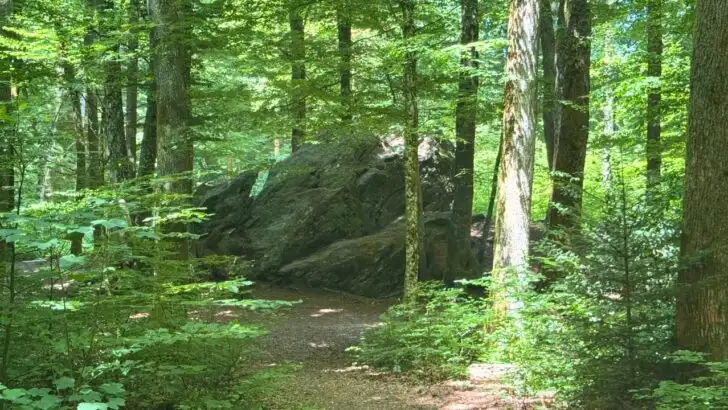
Out here in the forest, there’s no mulch delivery truck. No pruning shears. No gardener pacing around with a hose, second-guessing every leaf curl. And yet… it’s thriving. Every tree, fern, and moss patch looks like it knows exactly what it’s doing. No spreadsheets. No soil tests. Just balance.
Meanwhile, back in our backyards, we’re sweating through daily watering routines and muttering at aphids like they owe us rent. Something doesn’t add up.
Here’s the question: What does the forest know that we don’t? And what can we steal — respectfully — to make our gardens less stressful, more resilient, and honestly… a lot more fun?
This isn’t about turning your yard into a wilderness. It’s about borrowing nature’s best tricks — the ones that keep the forest going without a single drop of Miracle-Gro. The ones that let you do less, but grow more.
And yes, I really did write this while sitting in the woods. There’s moss under me, birds overhead, and I haven’t watered a single thing in three hours. Let’s talk about that.
Here are 11 genius forest-inspired tricks that might just change the way you garden forever — and give your knees a much-needed break.
🌿 Key Takeaways
- 🍂 Leave the leaves — they mulch, feed the soil, and support life just like in the forest.
- 🚜 Stop tilling — it disrupts soil life and isn’t necessary in a healthy garden ecosystem.
- 🍄 Encourage fungi — use mycorrhizal inoculants and compost to mimic forest networks.
- 🌳 Use shade strategically — not all plants want full sun, and shade reduces water stress.
- 🌾 Let some mess happen — logs, leaves, and wild corners attract helpful wildlife and build resilience.
- 🌿 Plant in layers — mimic forest structure with trees, shrubs, vines, and groundcovers.
- 💧 Water less, but smarter — build up soil with organic matter and train deeper roots.
- 🦉 Invite wildlife — birds, frogs, and insects all play key roles in garden health.
- 🌱 Plant perennials — long-living plants build stability and reduce rework each season.
- 👀 Observe before acting — not every yellow leaf needs intervention. Learn from the forest’s patience.
- 🕊️ Slow down — the forest doesn’t rush, and your garden doesn’t have to either.
1. Let the Leaves Fall Where They May
In the forest, nobody’s out there raking up leaves into biodegradable trash bags. The leaves fall, they stay put, and eventually they break down into some of the richest, fluffiest soil you’ll ever walk on. It’s not laziness. It’s strategy.
Here’s the trick: Leaves are nature’s mulch. They insulate soil, suppress weeds, feed microbes, and slowly turn into organic matter that plants love. And they do it for free.
If you’ve been clearing every leaf like you’re preparing for a royal visit, it’s time to stop. Shred them if you want them to break down faster, or just rake them into garden beds and walk away. The worms will take it from there.
Use this at home: In fall, skip the bagging and turn your yard waste into soil gold. In summer, collect dry leaves under trees or in shady areas and tuck them around your veggies as mulch. Instant forest magic.
The forest doesn’t clean up after itself — and that’s exactly why it stays so healthy. Your garden doesn’t need tidying, it needs time to decompose in peace.
2. Stop Tilling — The Forest Doesn’t
No one’s rototilling the forest floor. And yet somehow, every spring, saplings burst through layers of decaying leaves, moss, and whatever last year’s raccoons left behind. No soil flipping. No back pain. Just growth.
Why it works: Tilling destroys soil structure. It breaks up fungal networks, exposes beneficial microbes to sun and air, and lets weed seeds come roaring back like they own the place.
The forest thrives because its soil stays intact. Roots weave through layers of decomposing material. Fungi form long partnerships underground. Life builds on top of life. And somehow, everything still grows.
Use this at home: Try sheet mulching or top-dressing instead. Layer compost, cardboard, and mulch right on top of the soil. Plant into it. Let the worms do the tilling for you.
Your soil isn’t a cake to be mixed. It’s a whole living world — and the less you mess with it, the more it will give back. Channel your inner forest and let things settle.
3. Build a Fungal Network, Not Just a Garden
In the forest, trees don’t just grow — they whisper. Through roots. Through fungi. Through a vast underground network known as the mycorrhizal web. Yeah, it sounds like a magical elven internet, and honestly? It kind of is.
What’s happening underground: Fungi connect the roots of plants, helping them share nutrients, warn each other about pests, and access water more efficiently. Forests run on it. Your garden should too.
But here’s the kicker — tilling, over-fertilizing, and synthetic chemicals can wipe this network out. Fast. If your soil isn’t alive, your plants are basically texting with no signal.
Use this at home: Add mycorrhizal inoculant when planting trees, perennials, or new beds. Mulch deeply. Avoid synthetic fertilizers. Let the fungi move in and do their job — they’re better at it than you are.
The forest isn’t running on Miracle-Gro. It’s running on quiet, invisible partnerships under the soil. Your garden doesn’t need more inputs. It needs more alliances.
4. Embrace the Shade
In the forest, most plants aren’t baking under full sun. They’re thriving in dappled light, filtered through layers of canopy. They grow slower. Deeper. Smarter. And they’re not out here getting sunburned every afternoon.
Why this matters: Not every plant wants full sun, even if the label says so. Shade keeps roots cool, slows down evaporation, and makes life easier for pollinators, birds, and — let’s be real — you.
Full sun beds look great in magazines. But in real life? Shade brings balance. It’s the forest’s AC system. And your lettuce, ferns, and hydrangeas would all like a little bit of that, please.
Use this at home: Plant shade-loving companions under trees. Add vertical layers. Use trellises, pergolas, or even a strategically placed patio umbrella. You’re not cheating. You’re gardening like a forest.
Gardens don’t need to blaze in the sun to be beautiful. Sometimes the coolest spots grow the richest roots.
5. Let It Look a Little Messy
The forest is not tidy. There are no straight lines, no matching borders, no plastic plant labels. Half the magic is in the chaos — fallen logs, leaning trees, half-buried mushrooms that no one planted but everyone appreciates.
This isn’t neglect — it’s strategy: Messy patches attract beneficial insects. Decaying wood feeds the soil. Leaf litter shelters frogs, toads, and pollinators. It’s all part of the system.
We spend so much time trying to make our gardens presentable that we forget: nature doesn’t do symmetry. Beauty isn’t about control. It’s about layers, timing, and letting go a little.
Use this at home: Leave a corner wild. Skip that one weeding session. Let a log rot in peace. Plant natives and let them sprawl a little. Nature knows what it’s doing — your garden doesn’t always need you to micromanage it.
The mess isn’t a failure. It’s a feature. And honestly? It might be the healthiest part of your yard.
6. Think in Layers, Not Rows
In the forest, nothing grows in neat little lines. There are layers on layers — tall trees, understory shrubs, vines climbing, ferns spreading low, moss hugging the ground. It’s messy, yes. But it’s also wildly efficient.
This is how the forest gets more done with less:
- 🌳 Tall trees provide shade and wind protection
- 🌿 Shrubs fill the mid-layer with berries and blossoms
- 🌱 Groundcovers hold moisture and block weeds
- 🍇 Vines climb instead of crowding
- 🍄 Fungi and moss handle the cleanup and compost
Meanwhile, in our gardens? It’s often “tomatoes in a row” and “basil in a box.” Flat, thirsty, and high-maintenance.
Use this at home: Try planting in vertical layers — fruit trees with herbs beneath, vines on trellises, and shade-tolerant greens below. Every level supports the others, just like in the forest.
You don’t need more space — you need more structure. And nature already drew the blueprint for you. Just follow it, one layer at a time.
7. Stop Watering So Often
The forest is lush, green, full of life — and yet no one’s out here with a hose every morning. Trees don’t get drip irrigation. Ferns don’t demand constant misting. Somehow… everything just survives. Thrives, even.
Why it works: The forest floor is covered in organic matter — leaves, twigs, moss, fungi — that holds moisture like a sponge. And the soil is alive, so it actually helps regulate hydration naturally.
Compare that to your exposed veggie bed: dry mulch, bare soil, and roots that panic the minute the sun comes out. You water, the surface dries out, and the cycle begins again — stress, wilt, repeat.
Use this at home: Build up organic matter with compost and mulch. Add groundcovers. Water deeply, not frequently. Train your plants to grow deeper roots, not to expect constant hand-holding.
The forest doesn’t do shallow roots. Your garden shouldn’t either. Water smart, mulch heavy, and let nature do the rest — it’s had a lot more practice.
8. Invite Wildlife — On Purpose
In the forest, every creature has a job. Birds, frogs, snakes, beetles, bats — none of them are freeloading. They’re pollinating, fertilizing, eating pests, moving seeds. It’s basically a self-regulating workforce in feathers and fur.
And yet in our gardens? We chase off anything that flaps, buzzes, hops, or crawls — even when they’re helping us do the hard work.
We plant flowers but block the bees. We install raised beds and then freak out when a toad moves in. We spray for aphids and accidentally wipe out the ladybugs that were already handling it.
Use this at home: Add a small water source like a birdbath or shallow bowl. Plant native flowers. Leave a brush pile or a patch of wild growth. Skip the chemical sprays. Let nature come to you — and let it stay.
Wildlife isn’t the enemy. It’s the missing piece. The forest thrives because everything is part of the system. Your garden can too — if you let it.
9. Plant for the Long Haul
The forest doesn’t replant itself every spring. The oaks are still where they were last century. The ferns come back every year without anyone babysitting them. The mushrooms? They know exactly when to pop up, thank you very much.
Annuals are fun. Perennials are strategy. They build soil. They attract wildlife. They spread slowly (or not so slowly) and settle in for the long game — just like the forest does.
If you’re starting from scratch every year, you’re gardening on hard mode. Forests don’t do that. They invest. They grow into themselves. And that’s exactly what your garden should be doing, too.
Use this at home: Start adding perennial herbs, groundcovers, fruiting shrubs, native flowers, and trees. Think layers. Think decades. Think “I want to sit in the shade of this thing in 5 years.”
The best gardens aren’t made in a season. They’re built over time — just like forests. The earlier you plant for the future, the sooner it feels like home.
10. Observe Before You Intervene
The forest doesn’t panic when a plant droops. It doesn’t leap into action when a tree drops a few yellowing leaves. It just… watches. Waits. Adjusts. And 99% of the time, it rights itself.
Most garden mistakes happen when we act too fast: Overwatering. Over-fertilizing. Pruning too early. Spraying before checking. We treat every droop like a code red, when it’s probably just a plant taking a breath.
The forest doesn’t freak out. It responds. Slowly. Thoughtfully. And it survives storms, droughts, and the occasional squirrel uprising — without needing to be rescued every 15 minutes.
Use this at home: When something looks off, pause. Watch for a day or two. Check the soil. Check the weather. Ask yourself if you’ve really identified the problem — or if you’re just reacting. Then act, gently.
Your garden doesn’t need a hero. It needs a witness. The forest gets that — and your backyard will thank you for learning it too.
11. Garden with Patience, Like a Forest
The forest is never in a rush. Trees take years to reach full height. Mushrooms wait for the perfect moment. Nothing is chasing a calendar, trying to force blooms or checking soil pH every other day. And yet… everything gets done. Quietly. Brilliantly.
This is the part no one tells you: Patience is a garden skill. The forest doesn’t force things to grow. It creates the right conditions, and then it waits.
If your garden has become another to-do list, you’re missing the point. The best things in the garden — the self-seeded wildflower, the volunteer tomato, the hummingbird that shows up uninvited — don’t come from control. They come from space, time, and trust.
Use this at home: Start seeing your garden as a relationship, not a project. Show up. Pay attention. Do less. And give things the time they need — including yourself.
Forest gardening isn’t about going wild. It’s about slowing down. Listening more. Trusting nature. And remembering that everything you plant is already working its way toward something beautiful — whether you fuss over it or not.
This One Came Straight from the Woods
I didn’t plan this article. I didn’t even have my laptop with me at first. I was just walking through the forest — no agenda, no to-do list, just trying to clear my head — and I kept noticing things. How the leaves layered themselves. How the light filtered through. How the ground under my feet was soft, rich, and alive, without anyone managing it.
And it hit me: the forest is doing everything I’ve been trying to do in my garden… but better. And with a lot less effort.
I’m not saying throw out your gardening gloves. But maybe — just maybe — we could all let go a little more. Trust nature a little more. And stop trying to “fix” what isn’t broken.
The best ideas don’t always come from books, or blogs, or well-lit garden center aisles. Sometimes they come from just being outside and paying attention. That’s where this list came from. And honestly, I think it might be the most useful one I’ve written in a while.
If you’re feeling stuck in your garden, or overwhelmed, or just plain tired — try taking a walk in the woods. Bring a snack. Leave your expectations. And see what the trees are up to.


Daniel has been a plant enthusiast for over 20 years. He owns hundreds of houseplants and prepares for the chili growing seasons yearly with great anticipation. His favorite plants are plant species in the Araceae family, such as Monstera, Philodendron, and Anthurium. He also loves gardening and is growing hot peppers, tomatoes, and many more vegetables.