

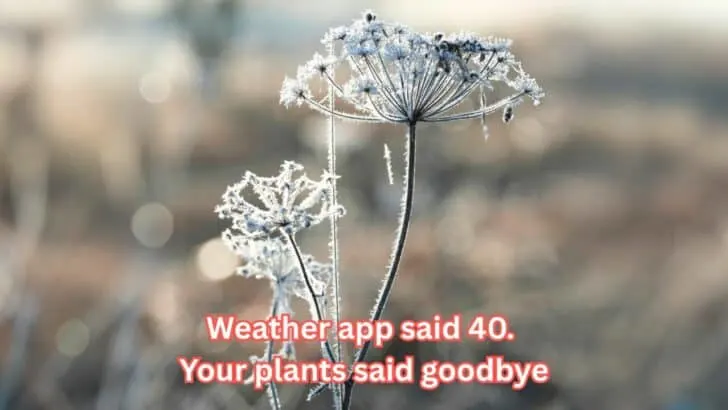
You wake up and something feels off. The grass looks stiff. The basil’s collapsed. And those tomatoes you were saving for “just a few more days”? Ruined. Not mushy. Not ripe. Just ruined.
That’s frost for you. It doesn’t wait for the calendar. It doesn’t come with fanfare. It shows up overnight, quietly wrecks your garden, and leaves you standing there in your pajamas wondering how the weather dropped that low without warning.
But here’s the thing: it wasn’t a surprise. Not really. First frost follows patterns. It gives clues. It even shows up on maps — if you know where to look.
This guide will show you what frost actually is, how to spot it coming, and what to do right now so you’re not standing in that yard full of regret.
🌿 Key Takeaways
- ❄️ Frost hits before you think it will — often above 32°F, and usually after a warm spell
- 📅 Your frost date is a guess — plan a few weeks ahead to stay safe
- 🌱 Not everything needs saving — protect your priorities, let the rest go
- 🪴 Prep covers early — buckets, sheets, row covers, whatever you’ve got
- ⏳ One extra week makes a difference — more harvest, more blooms, less regret
How Frost Sneaks Up on You
Frost doesn’t always wait for freezing temps. A lot of gardeners think 32°F is the line — but the real damage can start as high as 36°F. Especially on clear, still nights when the heat rises and the ground sheds warmth like it’s trying to get rid of it.
The air temperature might read safe, but your plants live closer to the soil — and that’s where frost hits first. Leaves get crisp. Fruit turns black at the tips. And basil? Basil gives up immediately. No warning. No goodbye.
The worst part? Frost usually shows up after a stretch of mild weather. That fake sense of safety? That’s how it gets you. You don’t notice the drop until it’s too late — and by then, your garden’s wearing a white dusting of disappointment.
Even if it’s just for one night, a light frost can end an entire season of work. But only if you let it.
🌡️ Bonus Tip: Read the Weather Like a Gardener
- Clear skies at night = higher frost risk (no cloud cover to hold heat)
- No wind? Even worse. Calm air lets cold settle at ground level
- Frost often hits lower spots first — cold air sinks
- Check the hourly low, not the daily low. That’s when damage happens
Know Your Frost Date — And Why It’s Just a Starting Point
Every gardener has a first frost date. Or at least, they’re supposed to. It’s the average date in your area when frost is likely to show up. But here’s the catch: “average” just means it happened that way half the time. The other half? It came early. Or late. Or sideways.
If you treat that date like a deadline, you’re gambling with your tomatoes. And your peppers. And everything else that doesn’t bounce back from a cold slap in the face.
To get it right, you need two things: your zone, and your *exact* location. Your garden might be warmer than your neighbor’s, or colder than the rest of the zip code. Microclimates are real — shady low spots get hit first, while raised beds or south-facing walls can stay frost-free longer.
Don’t trust the weather app alone. Use it, sure, but back it up with soil temp checks, sky-watching, and a little common sense. If your gut says it’s too cold to leave your feet uncovered, your basil probably agrees.
🧭 Bonus Tip: How to Find Your Frost Date
- Use the USDA Zone Map to find your zone
- Then check almanac.com/frostdates for your town’s specific frost info
- Track your own yard — start a garden journal or just scribble on the seed packet
3 Things You Should Do 3 Weeks Before Frost
Once you’re about three weeks out from your first frost, the clock starts ticking. This is the moment when gardeners split into two camps: the ones who coast and hope for the best, and the ones who still pull off a final harvest while everyone else is Googling “how to compost dead tomatoes.”
Here’s what to do while there’s still time:
1. Stop Fertilizing
It’s tempting to give your plants one last boost, but don’t. Fertilizer encourages soft, leafy growth that won’t survive cold nights. You want your plants to hunker down, not go through a growth spurt right before the cold snap.
2. Start Harvesting the Questionable Stuff
Anything that’s *almost* ready? Take it. Green tomatoes will ripen indoors. Basil can be chopped and frozen. Summer squash can be eaten small. Don’t wait for perfection — frost doesn’t care how close they were.
3. Get Your Covers Ready
Scrambling with a flashlight and a bedsheet the night of the first frost is a rite of passage, but it doesn’t have to be. Pull your old sheets, buckets, clothespins, and floating row covers now. Have them stashed and ready so you’re not cursing into the dark later.
🪴 Bonus Tip: Check the 10-Day Forecast Like a Farmer
- When nighttime temps dip below 40°F, you’re in the danger zone
- If a cold snap is coming, harvest first — worry about replanting later
- Use the hourly forecast — frost usually hits just before sunrise
What to Cover — And What to Let Go
Here’s where it gets tough. You can’t cover the entire garden. Not unless you’ve got a barn full of fleece and a very patient neighbor. You need to choose. Some crops are worth saving. Others? Let them go out with dignity.
Cover These First
- Tomatoes: Even green ones will ripen indoors, but the plant will die fast if you don’t protect it
- Peppers: Extremely frost-sensitive — they’ll wilt overnight
- Basil: One frost and it’s black mush. No second chances
- Squash & Cucumbers: If they’re still producing, a sheet can buy you a few more fruits
Don’t Bother Covering These
- Zinnias, Cosmos, Beans: Frost takes them out quick. Let them finish in peace
- Annual Flowers: Enjoy the last blooms, then say goodbye
No Cover Needed
- Kale, Carrots, Chard, Beets: These actually improve after a light frost — sweeter, sturdier, less bitter
- Spinach & Radishes: Handle frost like pros. No protection required unless it drops hard
💐 Bonus Tip: One Last Bouquet
- Harvest flowers like zinnias, cosmos, and marigolds the night before a frost
- Trim the stems, pop them in water, and enjoy them indoors while the garden resets
- It softens the blow — trust us
Tricks That Buy You More Time
Frost might be inevitable, but it doesn’t have to mean game over. With a little effort (and some creative rummaging), you can buy yourself a few extra days. Maybe even a couple more weeks. And in late-season gardening, that’s a big deal.
🧺 Use What You’ve Got
- Old sheets and towels: Light enough to drape, heavy enough to block frost
- Buckets and tubs: Flip over small plants overnight — remove in the morning
- Plastic bins or storage crates: Works great if you have random seedlings or container plants
🌡️ Add Some Thermal Mass
- Water jugs: Fill with water and leave next to plants — they absorb heat during the day and release it at night
- Black containers: Absorb more heat in the sun and warm the surrounding area
🏡 Move What You Can
- Container plants: Move them onto a porch, into a garage, or against a south-facing wall overnight
- Herbs: Basil, parsley, and mint all grow fine on a windowsill if you catch them in time
📆 Bonus Tip: One Extra Week = More Than You Think
- 7 extra days = more ripened tomatoes, more peppers, more cut flowers
- A single row cover can push your harvest window well into November
- Most of these tricks take 10 minutes or less — and they’re worth every second
You’re Not Too Late
Frost feels like the end — but it doesn’t have to be. A little planning, a few covers, and some quick harvests can turn that first cold snap into a footnote instead of a disaster.
You don’t need a greenhouse. You don’t need to panic. You just need to know your zone, trust the forecast, and cover what counts.
Let some things go. Protect the rest. And finish the season on your terms — not the weather’s.

Daniel has been a plant enthusiast for over 20 years. He owns hundreds of houseplants and prepares for the chili growing seasons yearly with great anticipation. His favorite plants are plant species in the Araceae family, such as Monstera, Philodendron, and Anthurium. He also loves gardening and is growing hot peppers, tomatoes, and many more vegetables.